
How the Model Context Protocol (MCP) Future-Proofs AI Agent Tool-Calling for Scalable, Secure, Interoperable Workflows

Agentic Assets Research Team
AI Solutions Architect
May 6, 2025
8 min read
Seamlessly connecting AI agents to external tools is the key to scaling intelligent automation, but until now, every integration came with headaches. The Model Context Protocol (MCP) is rewriting the rulebook, offering a universal, open standard that finally standardizes, simplifies, and future-proofs AI agent tool-calling for the next era of business and enterprise automation.
The Challenge: Fragmented, Fragile AI Agent Integrations
Before MCP, connecting large language models (LLMs) and AI agents to data sources and tools was a patchwork effort. Each new tool or API required custom wrappers, peculiar prompt engineering, and brittle code. Frameworks like LangChain and Auto-GPT brought some structure, but ultimately left developers trapped in a web of proprietary connectors, inconsistent outputs, and growing security risks. This fragmentation made it hard to scale or maintain agentic workflows, all while increasing time-to-market and operational costs (MarkTechPost).
Consequently, enterprises faced silos, vendor lock-in, and inconsistent security standards. In a world where innovation demands agile AI integration, “one-off” solutions simply couldn’t keep up.
The Model Context Protocol (MCP): A Universal Standard
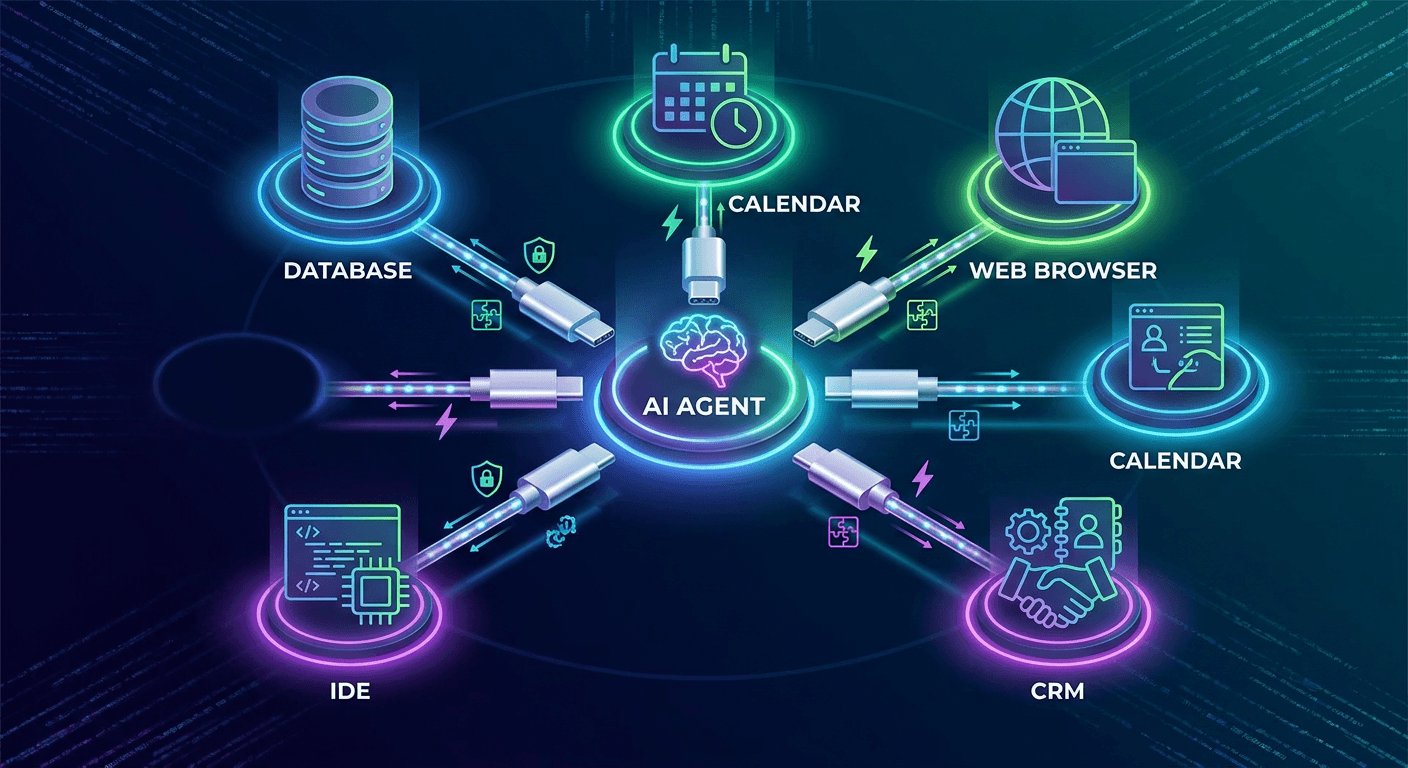
The Model Context Protocol (MCP) emerged as a direct response to these integration bottlenecks. Inspired by the Language Server Protocol (LSP) that standardized code intelligence in development tools, MCP does for agentic AI what USB-C did for hardware: it creates a universal, model-agnostic protocol for connecting AI agents to any tool, data source, or workflow (Model Context Protocol; Anthropic).
MCP leverages JSON-RPC 2.0, a simple, robust, and widely used remote procedure call framework. By defining how agents (clients), servers (tools/data), and hosts (interfaces) communicate, MCP eliminates the guesswork. Tools and resources are exposed with clear, standardized schemas, so agents can discover and execute functions without hand-crafted glue code for every new capability.
Core MCP Architecture: Three Roles, One Language
At MCP’s heart is its clear, role-based architecture:
- Host: The LLM-powered app or interface the user interacts with (for example, Claude Desktop or a code IDE).
- Client: The agent or SDK that speaks the MCP protocol, handling authentication, message passing, and coordination.
- Server: Any system, local or remote, that advertises tools, resources, and prompts in the standardized MCP format, wrapping databases, APIs, files, cloud services, or anything else (MarkTechPost).
This separation means anyone can develop an MCP server for a new data source or tool, and all compliant agents instantly gain access, no matter the programming language or model.
Key Features: Standardized Schemas, Secure Connections, Extensible Workflows
- Unified Tool-Calling: Every tool or resource describes itself in a standardized way, name, parameters, input/output schema, making it discoverable and callable at runtime.
- Composable Ecosystem: Multiple MCP servers plug into the same agent, enabling complex, cross-system workflows and allowing tool providers to publish new connectors for instant agent access.
- Security and Control: MCP’s design allows hosts to tightly control which tools or servers agents can access. Data stays secure via process sandboxes, encrypted transport, and authorization flows, although some security features like unified auth are the focus of ongoing development (MarkTechPost).
- Model and Vendor Neutrality: No more proprietary lock-in. Agents built on MCP standards can swap between LLM providers, deploy on-prem, or scale in the cloud, all while integrating new tools without major code rewrites (MarkTechPost Dev).
How MCP Works: From Discovery to Execution
When an agent launches, it contacts its allowed MCP servers. It calls list_tools() to learn what’s available, whether APIs, file systems, web search, or custom business logic. Each entry provides metadata, plus a description of required inputs and expected outputs. When the model determines a specific tool is needed, it generates a JSON-RPC call: the client forwards this to the server, receives the result, and loops the output back for further action or reasoning. This workflow is transparent, repeatable, and composable with multi-step templates or chained tool-calls (Anthropic).
Example use cases:
- Developer Productivity: IDEs like Zed or Replit leverage MCP to let AI-powered coding assistants ingest documentation, query databases, and review code history in real time.
- Enterprise Automation: Business chatbots tap directly into CRMs, helpdesks, or analytics tools using standardized MCP connectors, providing personalized answers or task automation without custom glue code.
- Retrieval-Augmented Generation (RAG): Agents use MCP to fetch relevant knowledge bases, graphs, or search results, improving the factual accuracy and flexibility of generative AI workflows.
- Proactive Agents: Event-driven assistants can monitor calendars, tasks, or communication streams, acting autonomously to schedule, summarize, and notify workers across compliant systems (Anthropic).
Implications for Business and Enterprise Automation
MCP solves some of the most persistent friction points slowing enterprise AI:
- Scalability: Write a server once, every compliant agent can use it. New tools, data sources, or workflows scale organization-wide without “rewiring” integrations for each team or vendor.
- Security and Governance: Organizations decide which servers or tools agents can access, enforce sandboxing, and monitor or audit agent activity. This is critical for sectors with strict compliance standards.
- Vendor Independence and Future-Proofing: MCP’s open spec enables quick pivots between LLMs or cloud providers, and guards against being trapped in proprietary stacks.
- Operational Agility: Fast deployment cycles and plug-and-play connectors mean less time wasted on “reinventing the wheel” for every integration, freeing teams to focus on business logic and real innovation (MarkTechPost Dev).
Limitations and What Comes Next
MCP is still new. Unified authentication, session management, and mass server discovery are developing rapidly. For quick, single-purpose integrations, the overhead of MCP might feel unnecessary, but its benefits shine in complex, evolving environments. As the ecosystem grows, so will the plug-and-play options for every industry (MarkTechPost).
Conclusion: A Universal USB-C for Agentic AI
MCP is on track to be the “USB-C port” of the AI world, one open, future-proof plug for any agent, on any stack, in any enterprise. For developers, enterprises, and AI architects, embracing this trend means stability, security, and agility to innovate as tooling evolves. Now’s the time to explore MCP and help shape the next generation of agentic automation.
Sources
- MarkTechPost - How the Model Context Protocol (MCP) Standardizes, Simplifies, and Future-Proofs AI Agent Tool Calling Across Models for Scalable, Secure, Interoperable Workflows
- MarkTechPost - Model Context Protocol (MCP) vs Function Calling: A Deep Dive into AI Integration Architectures
- MarkTechPost Dev - What is Model Context Protocol (MCP)? 5 Powerful MCP Servers You Need to Know
- Anthropic - Introducing the Model Context Protocol
- Model Context Protocol - Introduction
- MarkTechPost - Anthropic Open Sourced Model Context Protocol (MCP): Transforming AI Integration with Universal Data Connectivity
Share this article
Related Articles

Claude for Financial Services: Enterprise AI Platform Transforming Real Estate Finance in 2025
Discover how Anthropic's Claude for Financial Services is revolutionizing real estate finance through enterprise-grade AI agents, automated modeling, and seamless data integration, delivering proven 20% productivity gains across major financial institutions.

Multi-Agent AI Systems: Transforming Real Estate Finance with $34B in Projected Efficiencies
Discover how multi-agent AI systems are revolutionizing institutional real estate finance, with Morgan Stanley projecting $34B in operational efficiencies by 2030 through advanced automation and orchestrated workflows.
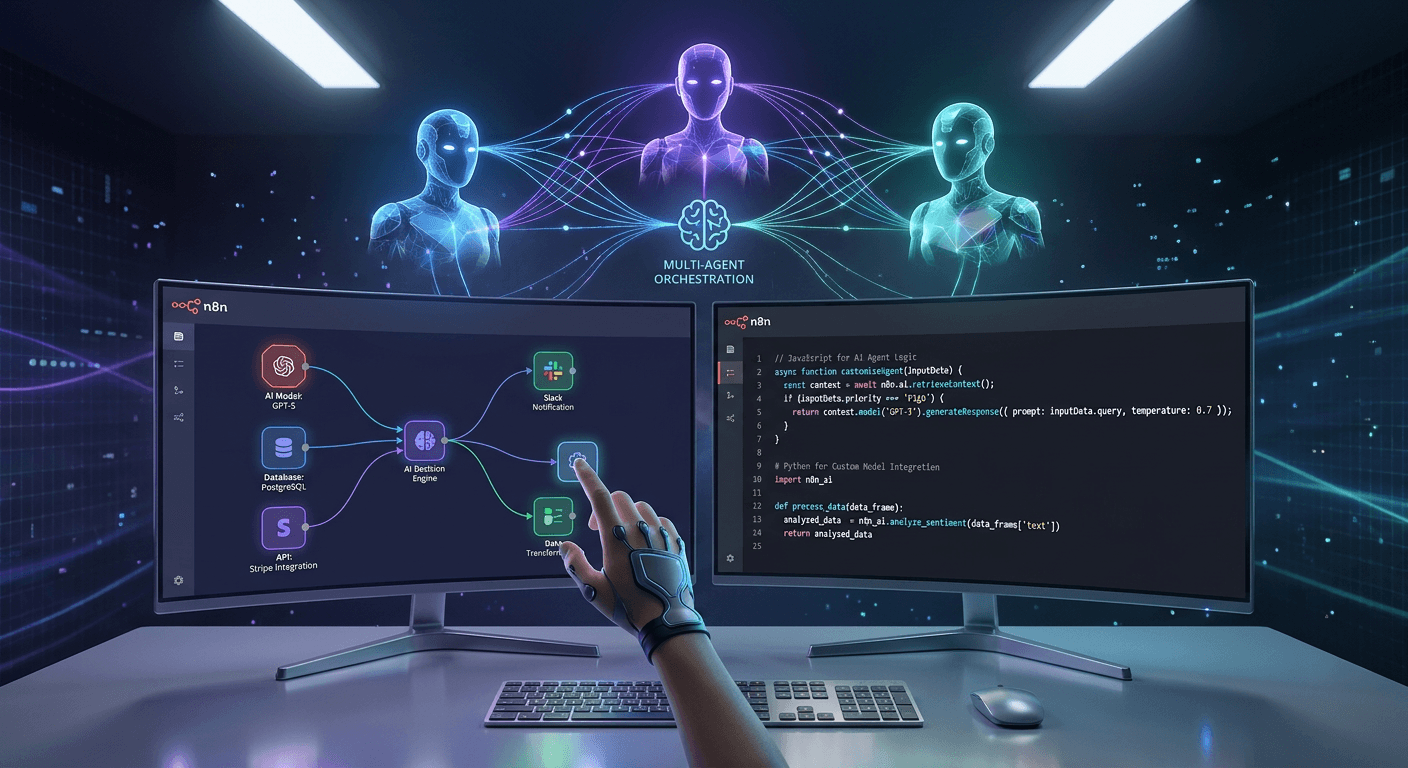
Why n8n Leads AI Agent Development in 2025: Hybrid No-Code/Code Power, Integrability, and Scalability
Discover how n8n’s unique blend of no-code flexibility and deep codability empowers enterprise-grade AI agent development and multi-agent orchestration, making it the premier platform for 2025 and beyond.