

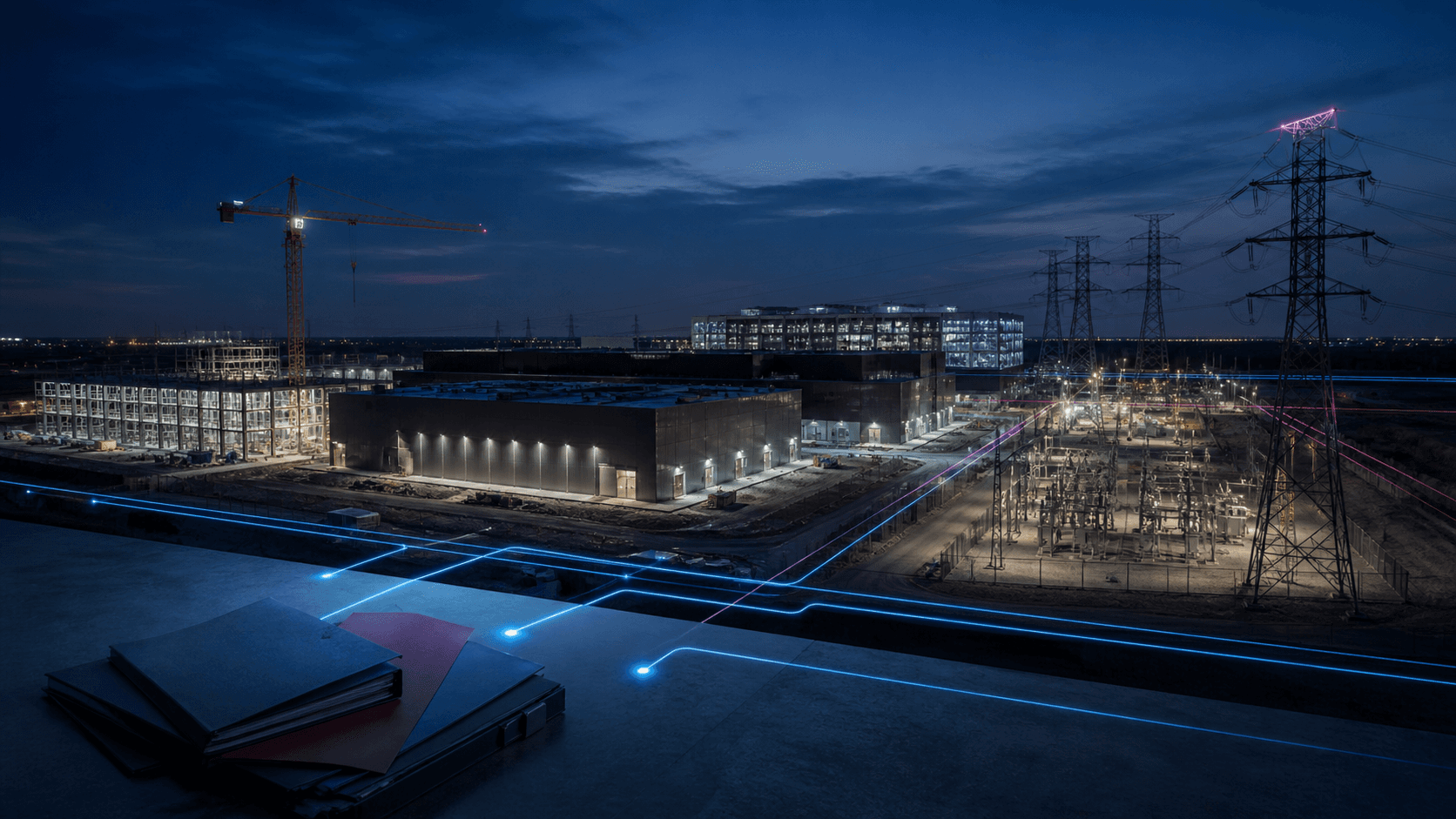
The AI Buildout Is a Financing Story Before It Is a Leasing Story

Agentic Assets Research Team
Agentic Assets Research
July 8, 2026
6 min read
Most coverage of the AI data center boom still leads with demand: how many gigawatts are under construction, how tight vacancy has become, how fast rents are rising. Those numbers matter, but they describe the leasing market. The more consequential story for commercial real estate capital markets is how the buildout is being paid for, and how that financing structure distributes risk across lenders, REITs, and public capital markets that were not designed to hold it.
A March 2026 working paper by Columbia's Stijn Van Nieuwerburgh, Financing the AI Buildout, frames the shift precisely. Because data centers are increasingly expensive, specialized, and technologically perishable, funding is moving away from simple on-balance-sheet corporate finance and toward leases, project finance, securitization, private credit, and special-purpose vehicles. That architecture expands how much debt the system can carry. It does not remove the underlying risk. It relocates it, concentrating exposure through tenant dependence, technology obsolescence, power and compute bottlenecks, and financing structures that are hard to see from the outside.
The buildout is leaving hyperscaler balance sheets
Reporting on the scale of this shift has been consistent since early in the year. Insurance Journal reported in February that AI-related companies raised at least 200 billion dollars in debt during 2025, with hundreds of billions more expected in 2026, spread across at least eight distinct channels: investment-grade corporate bonds, high-yield debt, convertible bonds, project finance loans, structured finance such as CMBS and ABS, off-balance-sheet special financing vehicles, private placements and private credit, and GPU-collateralized loans. A Bank of America executive quoted in the piece put the logic bluntly: hyperscalers have to turn over every available financing channel to make the buildout work.
An April 2026 analysis from law firm Foley & Lardner lays out the mechanics behind that shift. Project finance structures now run 60 to 80 percent loan-to-cost through special purpose vehicles secured by anchor tenant leases, often still backstopped by sponsor credit support rather than true non-recourse debt. Private credit funds are stepping in where banks move too slowly, offering flexible draw schedules and construction-risk tolerance that syndicated lenders will not take on, at a price. Capital markets absorb stabilized portfolios through investment-grade and high-yield issuance and securitization. Joint ventures with pension funds and sovereign wealth funds spread the equity check but add governance complexity. Each channel looks reasonable in isolation. Together they mean a growing share of AI infrastructure risk sits with real estate lenders, insurers, and structured-credit investors who are underwriting a tenant credit and technology-obsolescence profile that looks nothing like a traditional office or industrial lease.
Power, not capital, is the constraint setting the pace
CBRE's Global Data Center Trends 2026 report, published in June, is explicit that power availability, not demand or even capital, is now the binding constraint on new supply. Interconnection timelines in established hubs have stretched further, with some Chicago-area utility queues not clearing until 2032, while cities including Amsterdam have imposed outright megawatt moratoriums on new large loads. Despite double-digit inventory growth in North America and Latin America, vacancy in core markets remains near zero, with Northern Virginia at roughly 0.3 percent, and CBRE expects throttled construction timelines to keep U.S. supply constrained through 2030.
That combination, scarce power and abundant capital chasing it, is exactly what pushes financing further out the risk curve. Operators are underwriting behind-the-meter generation and bring-your-own-power arrangements as the base case rather than the exception, which adds construction complexity and cost to projects that lenders are already financing on aggressive timelines. When a facility's in-service date depends on a private power solution instead of a regulated utility tie, the project finance package backing it inherits a construction and operating risk that used to sit with utilities, not with CRE debt investors.
Credit markets are starting to price the downside
Rating agencies have been the clearest voice on where that risk shows up first. Moody's has flagged that data center securitizations, which had already reached roughly 9 billion dollars in CMBS and ABS issuance through early 2025, are exposed on two fronts: tenant demand falling short of what capacity assumes, and landlords needing to raise capital spending to avoid technological obsolescence as chip generations turn over faster than the debt amortizes. Moody's also notes that developers are leaning more heavily on structured finance and longer development timelines, which raises refinancing and execution risk even before a facility opens. None of this means the sector is mispriced across the board. Rated REITs with diversified portfolios and disciplined growth still carry meaningfully less exposure than single-asset project finance vehicles or sub-investment-grade neocloud tenants, whose lease credit increasingly needs parent guarantees or hyperscaler backstops to clear underwriting.
The systemic question the BIS put on the table
The clearest statement of the macro-financial stakes came from the Bank for International Settlements' Annual Economic Report, published June 28. The BIS estimates the five largest hyperscalers will spend more than a trillion dollars on AI-related capital expenditure across 2025 and 2026 combined, a sum that already exceeds their combined earnings and free cash flow and is forcing debt issuance to close the gap. The report singles out circular financing arrangements, in which chipmakers and hyperscalers take equity stakes in AI labs and neocloud providers that in turn commit to multi-year chip and compute purchases, as a source of opacity and potential double-pledging of the same underlying assets. Its warning is not that the buildout is unsound today. It is that every major hyperscaler is making a similar bet at the same time, and that a disappointment in AI returns could turn a concentrated capex boom into what the report calls a protracted investment bust, with financing pulling back faster than the physical assets can be repurposed.
What this means for CRE capital markets
For lenders, insurers, and institutional allocators, the practical implication is not to avoid data center exposure. It is to underwrite it as a hybrid credit, not a real estate credit. That means testing tenant concentration and parent guarantees the way a corporate credit desk would, stress-testing power delivery dates the way an infrastructure lender would, and pricing technology obsolescence into loan terms the way a project financier would. It also means asking where a given exposure sits in the financing stack, since a diversified REIT ground lease and a single-asset private credit facility behind an unrated neocloud tenant can carry the same headline yield and very different loss profiles. The AI buildout will keep generating real estate transactions. Which of those transactions are financeable on defensible terms depends less on how fast demand is growing than on how clearly the capital behind it can be traced back to a tenant, a power contract, and a balance sheet that can actually absorb the risk.
Share this article
Related Articles
When Power Becomes a Credit Condition: Data-Center Underwriting After PJM’s July Filing
PJM’s July 2026 reliability proposal is a timely reminder that a data center’s power plan is not a permitting footnote. It is an underwriting input that can affect timing, capacity, operating continuity, and the allocation of project risk.
AI Is Moving Into the Physical Economy, and CRE Is the Balance Sheet
The next AI investment wave is not only model labs and software. It is power, land, data centers, industrial operations, and the real estate balance sheet underneath them.

AI Adoption Is Becoming a Macro-Financial Real Estate Question
AI is not only changing office tasks. It is changing labor demand, capital expenditure, credit narratives, and the way real estate investors should think about stress tests.